For most cable manufacturers, ERP is the right place to start.
When the business is smaller, the priorities are straightforward. Improve control over purchasing, finance, and customer orders. Create more structure across the business. Build a stronger foundation for planning and decision-making.
That is why ERP becomes the backbone for so many growing cable manufacturers. It brings consistency, improves visibility across the business, and helps teams move away from disconnected spreadsheets and fragmented decision-making. For any operation, it is the smart and sensible foundation.
The challenge is that growth changes what the business needs from its systems.
As a cable manufacturer scales, the issue is no longer just business control. It becomes shop-floor control. More orders and more production activity create a stronger need for real-time visibility during execution. Growing businesses often find it harder to keep track of inventory, stay on top of production progress, and deliver on time. At the same time, customer expectations rise, especially around quality and traceability.
Supervisors need better insight into work in process, material usage, and production events as they happen. Traceability becomes more important because quality issues and customer claims are harder to manage without a clear production history. Management also needs a clearer connection between what was planned, what is running, and what has actually been produced.
This is where ERP starts to show its limits. It is built to support planning, transactions, and business control, but not to give the shop floor the real-time visibility needed to manage production as it happens.
The Real Issue Is Not Only Planning; It Is Execution Too.
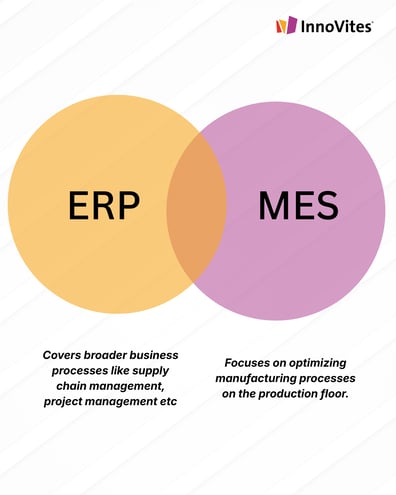
ERP is very good at running the business side of manufacturing. It helps manage orders, materials, inventory, procurement, and financial control. It tells the organization what should be made, what should be purchased, and what should be delivered.
But the shop floor works differently.
Production happens in real time. Conditions change. Lines stop. Quality issues appear. Operators need direction. Supervisors need immediate visibility. Management needs to know not only what was planned but also what is actually happening while production is running.
That is why ERP and MES should not be treated as the same thing.
ERP is built around planning, transactions, and coordination across the business. MES is built around execution, plant-floor visibility, and control during production.
An ERP system can confirm that an order was completed. A good MES helps the manufacturer understand how it was completed, what happened during production, whether the process stayed in control, and where action is needed before small issues become expensive ones.
In wire and cable manufacturing, small changes during production can quickly affect quality, material consumption, traceability, and consistency. That is why managing the shop floor requires more than issuing work orders and reporting finished output.
As operations grow, teams need better visibility into what is happening on the line while production is still running.
This is where the cracks usually start to show.
- Teams often end up relying more on spreadsheets to track production status, material consumption, quality checks, and order progress outside the system.
- Production updates often come in after the shift, or at a level too high to help supervisors respond to stoppages, material issues, or quality deviations in time.
- When a customer raises a quality claim, teams often have to trace the issue back manually through production records, material batches, and operator notes instead of having that history readily available.
- Supervisors often rely on experience, side conversations, and workarounds to understand what is happening on the line, where delays are building up, and which issues need attention first.
None of this means ERP has failed.
It means the plant has reached a level of complexity that needs a system designed for manufacturing execution, not just business administration.
Next Step In Manufacturing Maturity: A Separate MES
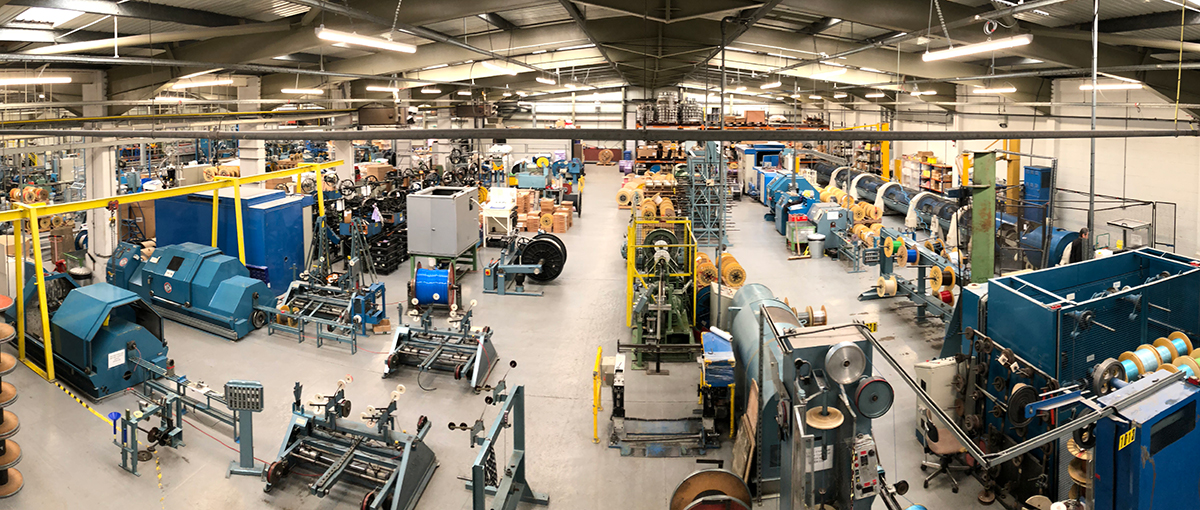
This is where an MES becomes valuable.
More than a technology platform, it acts as the backbone for manufacturing visibility, coordination, and control.
ERP should remain the backbone of the business. It should continue to own enterprise planning, transactions, procurement, inventory, and financial visibility. MES should own execution on the plant floor. It should support real-time production visibility, stronger traceability, and a clearer connection between what was planned and what was actually produced.
When those roles are clear, the digital foundation becomes stronger, not more fragmented.
ERP continues to do what it does best. Manufacturing gets the shop-floor visibility it actually needs. Leadership gains a clearer view of what is happening during production. The plant becomes less dependent on spreadsheets, manual follow-up, and tribal knowledge. And the business is better positioned to scale with control instead of compensating with workarounds.
For growing cable manufacturers, that is where digital maturity begins to take shape. ERP continues to anchor the business, but manufacturing needs deeper operational support than ERP alone can provide. Once execution, traceability, and plant-floor visibility start to matter more, a dedicated MES stops being an add-on and becomes a necessary part of scaling well.